
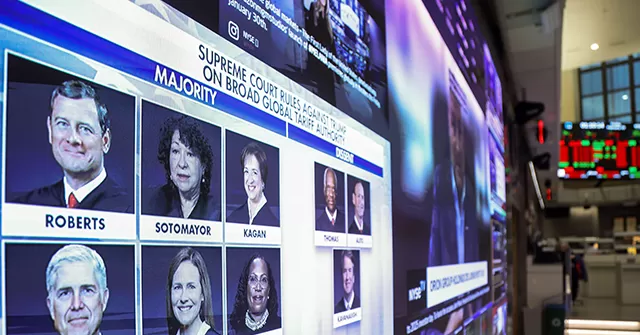
The Supreme Court of the United States has made a landmark decision, invalidating President Trump’s sweeping tariff policy. In a ruling of 6-3, the court declared that the International Emergency Economic Powers Act (IEEPA) did not grant the president the authority to impose tariffs. This judgment has significant implications for the economy and trade relations of the United States.
The case was brought before the court by several businesses and trade organizations who argued that the president’s use of IEEPA to impose tariffs on goods from China and other countries was unconstitutional. The IEEPA, passed in 1977, gives the president the power to declare a national emergency and impose economic sanctions in response to an extraordinary threat to the United States. However, the court ruled that the use of this power to impose tariffs on foreign goods was beyond the scope of the law.
This decision is a significant blow to President Trump’s trade policies, which have been a cornerstone of his administration. Since taking office, the president has been a vocal advocate of imposing tariffs on foreign goods, arguing that it would protect American industries and jobs. However, this decision by the Supreme Court has now put a check on the president’s power to unilaterally impose tariffs and has reaffirmed the role of Congress in matters of trade.
The implications of this ruling are far-reaching. It not only affects the ongoing trade war with China but also has an impact on the president’s ability to impose tariffs on other countries. With the court’s decision, it has become clear that the president cannot use national security as a justification for imposing tariffs, and any such action must be authorized by Congress.
This ruling has been welcomed by many in the business community and trade organizations. They argue that the president’s use of tariffs has disrupted global supply chains, increased costs for businesses and consumers, and damaged relationships with trading partners. The decision by the Supreme Court is seen as a step towards restoring stability and predictability in the market.
The court’s decision also has significant implications for the future of US trade policy. With the president’s power to impose tariffs curtailed, it is expected that there will be a shift towards more bilateral trade agreements. This could lead to a more stable and mutually beneficial trade environment for the United States.
However, this ruling does not mean an end to the ongoing trade disputes with China and other countries. It is expected that the president will continue to use other trade tools at his disposal, such as Section 301 of the Trade Act of 1974, to address trade imbalances and unfair practices by foreign countries. But with the Supreme Court’s decision, the president’s power to do so unilaterally has been limited, and any such actions will need to be in accordance with the law and congressional approval.
In the aftermath of this ruling, it is essential to look towards the future and consider what comes next. The Trump administration must now work with Congress to develop a more comprehensive and strategic approach to addressing trade issues. This includes addressing the trade deficit, protecting American industries and jobs, and promoting fair and reciprocal trade agreements.
The Supreme Court’s decision has also sent a clear message to the international community that the United States remains a country of laws and principles. It has reaffirmed the checks and balances of the US government and the vital role of the judiciary in upholding the Constitution.
In conclusion, the Supreme Court’s ruling to strike down President Trump’s sweeping tariff policy is a significant victory for the rule of law and the American economy. It has put a check on the president’s power to unilaterally impose tariffs and has reaffirmed the role of Congress in matters of trade. This decision sets the stage for a more strategic and collaborative approach to trade policy in the future. It is a step towards a more stable and mutually beneficial trade environment for the United States and its trading partners.


![Complete BritRail Pass Guide [Types, How to Use It, Pros + Cons]](https://inside-news.uk/wp-content/uploads/2025/06/00221EB4-BCA2-4DBB-6CD4-83DBC37D71FA-120x86.webp)