
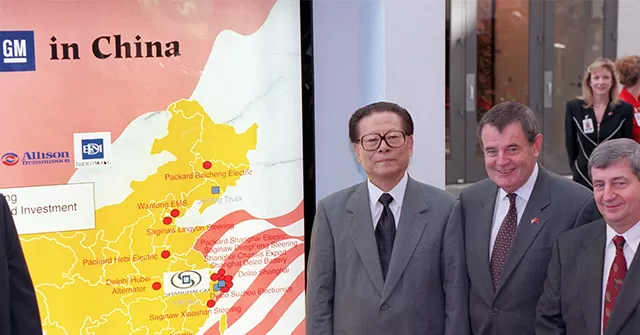
For decades, American companies have been drawn to China’s vast potential as a consumer market and its low-cost labor. In order to gain access to this lucrative market, these companies have willingly shared their technology with Chinese partners. However, this decision has come with a cost, one that has been largely overlooked until now. A recent report from Breitbart Business Digest has shed light on how the United States has inadvertently given away its technology edge to China.
The exchange of technology for market access was a simple and seemingly logical calculation made by American companies. After all, China has a population of over 1.4 billion people and a rapidly growing economy. It was seen as an opportunity too good to pass up. However, as the saying goes, “there’s no such thing as a free lunch.” In this case, the price of market access was the transfer of technology, and it has had far-reaching consequences.
One of the most startling revelations from the Breitbart report is that China has been systematically stealing technology from American companies for years. This has been done through various means, including forced technology transfer, cyber espionage, and intellectual property theft. According to the report, these actions have cost the United States an estimated $600 billion annually in intellectual property theft alone. This is a staggering amount that has not only hurt American companies but also the overall economy.
But how did this happen? How did the United States, a global leader in technology, allow China to gain the upper hand? The answer lies in the shortsightedness of American companies and the lack of protection from the US government. In their pursuit of greater market share and profits, American companies turned a blind eye to the potential consequences of sharing their technology with Chinese partners. And the US government, in an effort to maintain good trade relations, did not do enough to prevent or address these actions.
The ramifications of this technology transfer have been far-reaching and have had a significant impact on the US economy. As China gains access to advanced technology, it has been able to increase its own production capabilities and develop its own industries. This has led to a decrease in demand for American-made products and a loss of jobs in the US. Additionally, as China becomes more technologically advanced, it has been able to compete with American companies on a global scale, further hurting the US economy.
But it’s not just the economic impact that is concerning. The transfer of technology to China has also raised national security concerns. China’s growing technological capabilities pose a threat to US national security, as it can potentially use this technology to develop advanced military weapons and surveillance systems.
So, what can be done to address this issue? The first step is to acknowledge that there is a problem. American companies must be more vigilant in protecting their technology and the US government must take a stronger stance in protecting American interests. This could include stricter regulations on technology transfer and increased efforts to address intellectual property theft.
Furthermore, American companies must also consider the long-term consequences of sharing their technology with Chinese partners. They must weigh the short-term benefits against the potential long-term costs, not just for their own company but for the country as a whole.
In conclusion, the report from Breitbart Business Digest serves as a wake-up call for both American companies and the US government. The transfer of technology to China has had a significant impact on the US economy and poses a threat to national security. It’s time to re-evaluate the cost of market access and take necessary steps to protect American technology and interests. As the saying goes, “an ounce of prevention is worth a pound of cure.” It’s time to take action before it’s too late.


![Complete BritRail Pass Guide [Types, How to Use It, Pros + Cons]](https://inside-news.uk/wp-content/uploads/2025/06/00221EB4-BCA2-4DBB-6CD4-83DBC37D71FA-120x86.webp)